

In the absence of monthly permit data due to the (now ended) government shutdown, we thought it was an opportune time to zoom out and take a look at annual permits over the long-term to put our current situation into perspective. In looking at permit data for the Phoenix Metro going back to 1980, we make the following observations (the “Currently” numbers below are the trailing 12 months through August 2025):
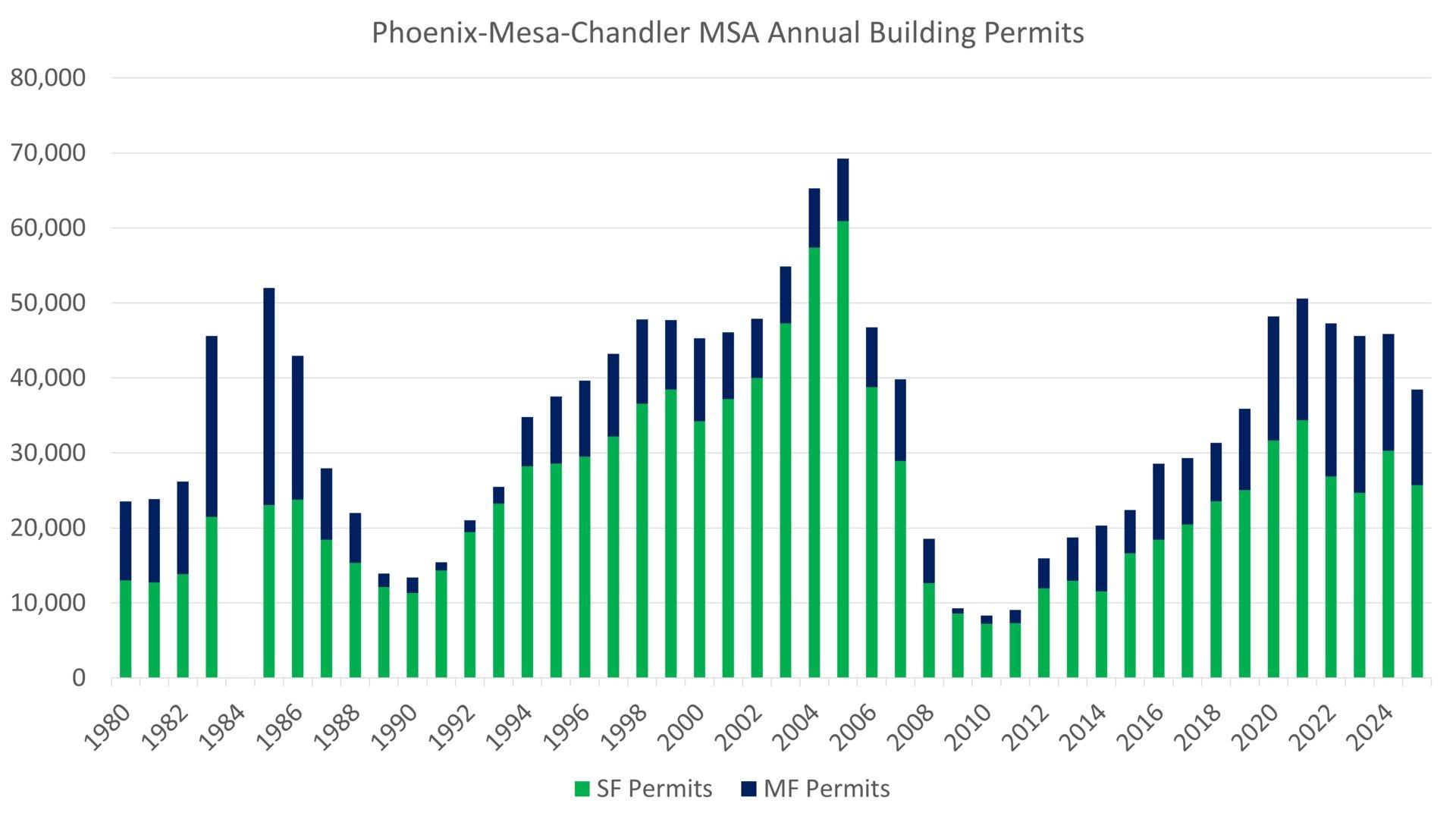
Peaks:
Single Family
23,758 in 1986 (sort of a ‘mini-peak’)
60,926 in 2005 (19 years from previous peak)
34,347 in 2021 (16 years from previous peak)
25,713 Currently
Multifamily
28,914 in 1985 (1984 data is missing, but this does appear to be the peak)
11,240 in 1998 (13 years from previous peak, also a ‘mini-peak’)
20,908 in 2023 (25 years from previous peak)
12,729 Currently
Combined
51,980 in 1985
69,230 in 2005 (20 years from previous peak)
50,581 in 2021 (16 years from previous peak)
38,442 Currently
Something that stood out to us when researching these numbers was the sheer volume of single family permits issued during the pre-GFC run-up. From 1998 through 2006, the Phoenix Metro issued more single family permits each year than we did in the most recent peak year of 2021 (aside from 2000 when they dipped to 34,232 vs. 2021’s 34,347).
Troughs:
Single Family
11,304 in 1990
7,212 in 2010 (20 years after previous trough)
25,713 Currently
Multifamily
1,098 in 1991
674 in 2009 (18 years after previous trough)
12,729 Currently
Combined
13,378 in 1990
8,300 in 2010 (20 years after previous trough)
38,442 Currently
Looking at the 674 multifamily permits in 2009 seems unfathomable, but we were around during those times and it also seems like a miracle any units were permitted at all during that time. Coming out of the GFC, developers could’ve had any multifamily site in town for cheap and the cities were welcoming of any kind of development. Not quite the same these days…
Full Cycle Averages:
Single Family
30,423 Peak to Peak, 1986 - 2005 (19 Years)
30,237 Trough to Trough, 1990 - 2010 (20 Years)
21,818 Peak to Peak, 2005 - 2021 (16 Years)
25,713 Currently
Multifamily
8,640 Peak to Peak, 1985 - 1998 (13 Years)
7,325 Trough to Trough, 1991 - 2009 (18 Years)
9,101 Peak to Peak, 1998 - 2023 (15 Years)
12,729 Currently
Combined
38,735 Peak to Peak, 1985 - 2005 (20 Years)
37,015 Trough to Trough, 1990 - 2010 (20 Years)
29,549 Peak to Peak, 2005 - 2021 (16 Years)
38,442 Currently
When looking at these numbers, there is no perfect level of permitting that will keep us in some state of blissful equilibrium. However, we think the numbers provide a framework of how to view where the market stands from a new development standpoint. Healthy ranges seem to be for single family permits between 22,000 - 30,000, multifamily permits between 7,000 - 9,000 and combined 30,000 - 40,000.
If and when permits are falling below those levels, it might be time for developers to get aggressive with their land acquisition strategy to take advantage of lower levels of competition. Landowners may want to wait for better days, as land values will generally be down when permits are trending lower.
When permits are trending above those ranges, developers would be well-served to be a little more cautious. The market has proven it can sustain elevated permits for several years, but at that point, the clock is ticking and we don’t know when the market will turn.
Landowners might strongly consider selling (if they haven’t already) to avoid missing the peak and riding out a falling market or being forced to wait for a recovery to achieve their target pricing. The cycles shown above range from 13 - 20 years, showing that real estate market recoveries don’t turn on a dime.
Thanks for reading, as always, please reach out with anything we can help you with.
Thanks,
John & Ramey
John Finnegan
Senior Vice President | Land
(602) 222-5152
Ramey Peru
Senior Vice President | Land
(602) 222-5154