


There’s a number getting tossed around Phoenix that needs some context: $753 million.
That’s roughly what a group of property owners demanded from the City after Phoenix adopted new data-center zoning rules in 2025.
You may have seen it described as $753 million in “lawsuits,” but most of those were Prop 207 demands filed with the City, not court cases. Only one major dispute that we’re aware of has clearly moved into active litigation.
That distinction is the heart of this story, because Prop 207 was designed to change government decisions before anyone ends up in a courtroom.
A 20-year-old law with real teeth
Arizona voters approved Proposition 207 in 2006 by nearly two to one (64.8% to 35.2%). Today it’s known as the Private Property Rights Protection Act, A.R.S. §§ 12-1131 through 12-1138.
The political backdrop was Kelo v. City of New London, the 2005 U.S. Supreme Court decision that allowed eminent domain for an economic-development project. The initiative cited Kelo directly, along with a handful of local condemnation fights.
The provision landowners should care about today has very little to do with bulldozers:
If government adopts a new land-use rule after you acquire your property, and that rule reduces your existing rights to use, divide, sell or possess it and lowers its fair market value, you may be owed compensation.
If you own land in Arizona, that’s an unusual and valuable property right. Most states give cities a lot more room to change zoning without writing a check, but Arizona voters went a different direction.
Then Phoenix changed the rules for data centers
On July 2, 2025, Phoenix adopted Ordinance G-7396. It did three things:
A new definition. For the first time, “data center” became its own zoning use.
A special permit. Data centers now need one in several commercial and industrial districts (C-2, C-3, CP/GCP, A-1 and A-2), where they previously fit under broader permitted uses.
New standards. The City can address fire risk, power, water, generators, hazardous materials and noise, and the ordinance adds siting, design and utility-service requirements.
Some of that makes sense, since a 200-plus-megawatt data center is a very different animal than the server rooms that existed when most industrial codes were written.
The catch is that zoning also creates value. If industrial land is worth more because a data-center buyer can build by right, swapping that right for a discretionary permit changes what a buyer is willing to pay.
Prop 207 makes government deal with that difference, and Phoenix clearly saw it coming: the City wrote a Prop 207 waiver procedure directly into the ordinance before the first claim ever showed up.
Eleven claims. Four waivers. One lawsuit.
Here’s where things stand so far:
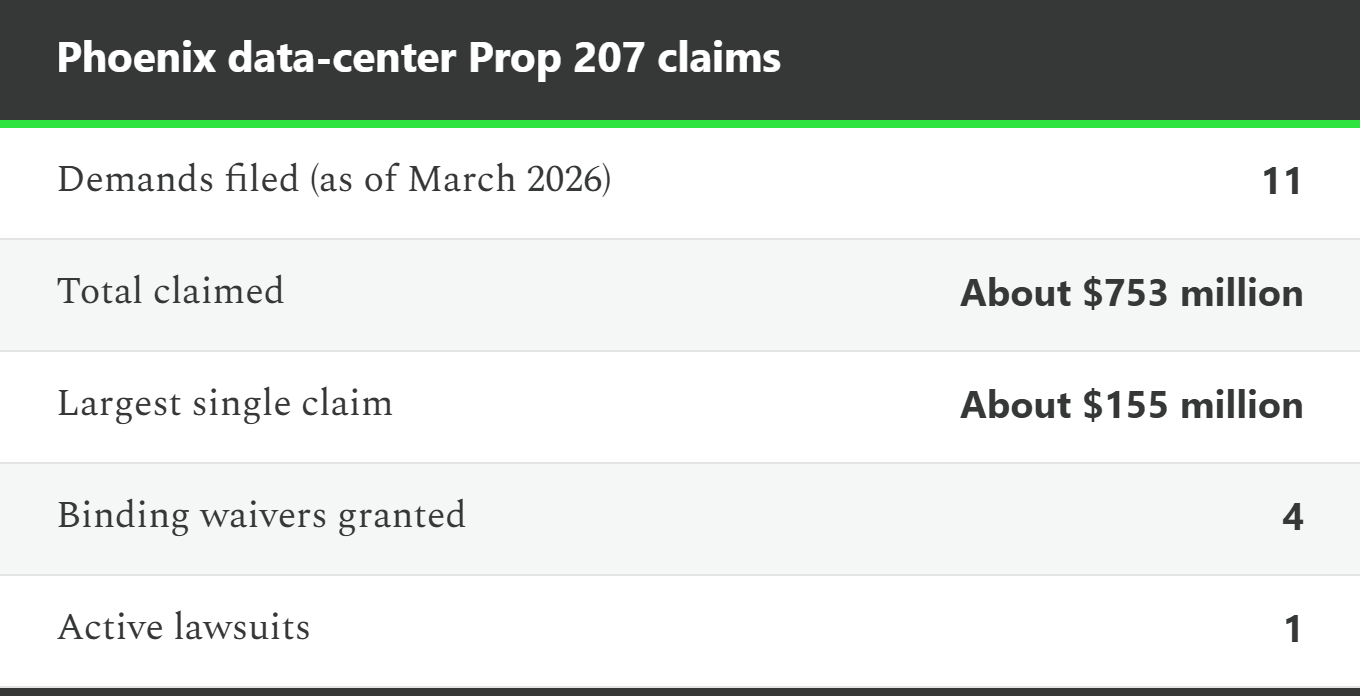
Keep in mind that these are claims, not verdicts, and an owner saying a rule cost it $100 million doesn’t mean the land actually lost $100 million.
In several cases, Phoenix went a different route and granted binding waivers, letting the parcel skip the new special-permit requirement, to four claimants: LKY Real Estate Fund IV, the Sheely ownership, Aligned Data Centers and 5C Data Centers.
Aligned is a good example of how this plays out. The company demanded $75.4 million over its Deer Valley-area property near 31st Avenue and Behrend Drive. Rather than pay it, the City approved a waiver in March 2026 letting the property move forward without the special permit, though other zoning and code requirements still apply.
Granting the waiver doesn’t mean the City conceded $75 million in lost value. It shows Prop 207 working the way it was intended, resolving the dispute outside of a courtroom.
The real power of Prop 207 is the choice it forces on government: enforce the new restriction, pay for the value it takes, or waive the restriction on that property.
The case we’re watching: West Buckeye Road
West Buckeye Road LP v. City of Phoenix could tell us a lot more.
West Buckeye owns about 70 acres near 99th Avenue and Buckeye Road. The owner says it bought the industrial property in 2021, invested in getting it ready for data-center development, then watched Phoenix change the rules in 2025. Its demand claims more than $54 million in lost value.
Phoenix’s defense: The ordinance falls under Prop 207’s health-and-safety exemption, a legitimate carve-out that expressly covers fire codes, pollution controls, traffic regulations and sanitation rules.
The problem for cities: In Sedona Grand v. City of Sedona, the Arizona Court of Appeals held that calling something a health-and-safety measure isn’t enough. The city has to prove that protecting health and safety was the rule’s principal purpose.
Where it stands: A Maricopa County judge dismissed a separate theory under the ordinance itself but let the Prop 207 claim move forward. Phoenix now has to prove its defense at an evidentiary hearing, which was set for November 17.
What this means if you own land
Prop 207 belongs in your acquisition and entitlement due diligence. It shouldn’t be something you find out about after a zoning fight has already started. Five points stand out:
Check when you bought it. The rule generally has to come after the property was transferred to you.
Know what’s allowed now. A use that’s permitted today is a much stronger position than hoping for a future rezoning.
Be ready to prove the loss. Lost use has to translate into a defensible drop in fair market value, tied to the specific rule.
Don’t miss the deadlines. Prop 207 has its own three-year limit, but Arizona courts also require a much shorter government notice-of-claim filing.
Watch what you sign. Arizona cities routinely ask for Prop 207 waivers when owners request rezonings, and those waivers can run with the land.
For developers, zoning isn’t just another line item on the entitlement checklist. When a use commands a big premium, the right to build it can be a meaningful share of what the land is worth.
Our takeaway
Prop 207 doesn’t freeze Arizona zoning in place, and cities can still regulate land.
What it does is make some of those decisions expensive: a city council can decide a use no longer belongs somewhere, but if the city allowed that use before and owners bought land relying on it, Arizona law may put a price on changing course.
With data-center land trading at values that were hard to imagine ten years ago, Phoenix is finding out in real time that the price can run into the tens or even hundreds of millions of dollars.
This discussion is about real estate and land-use issues, not legal advice. Prop 207 claims are extremely fact-specific, and the notice and filing requirements can be unforgiving.
Until Next Time,
Ramey Peru & John Finnegan
Senior Vice Presidents | Land
ramey.peru@colliers.com | john.finnegan@colliers.com
(602) 228-3638 | (602) 405-5212
Connect with Ramey on LinkedIn | Connect with John on LinkedIn